
Commercial Mold Remediation in Los Angeles: A Facility Manager's Guide
By DKI Restotech Team · Jul 27, 2026 · Updated Aug 31, 2026 · 3 min read
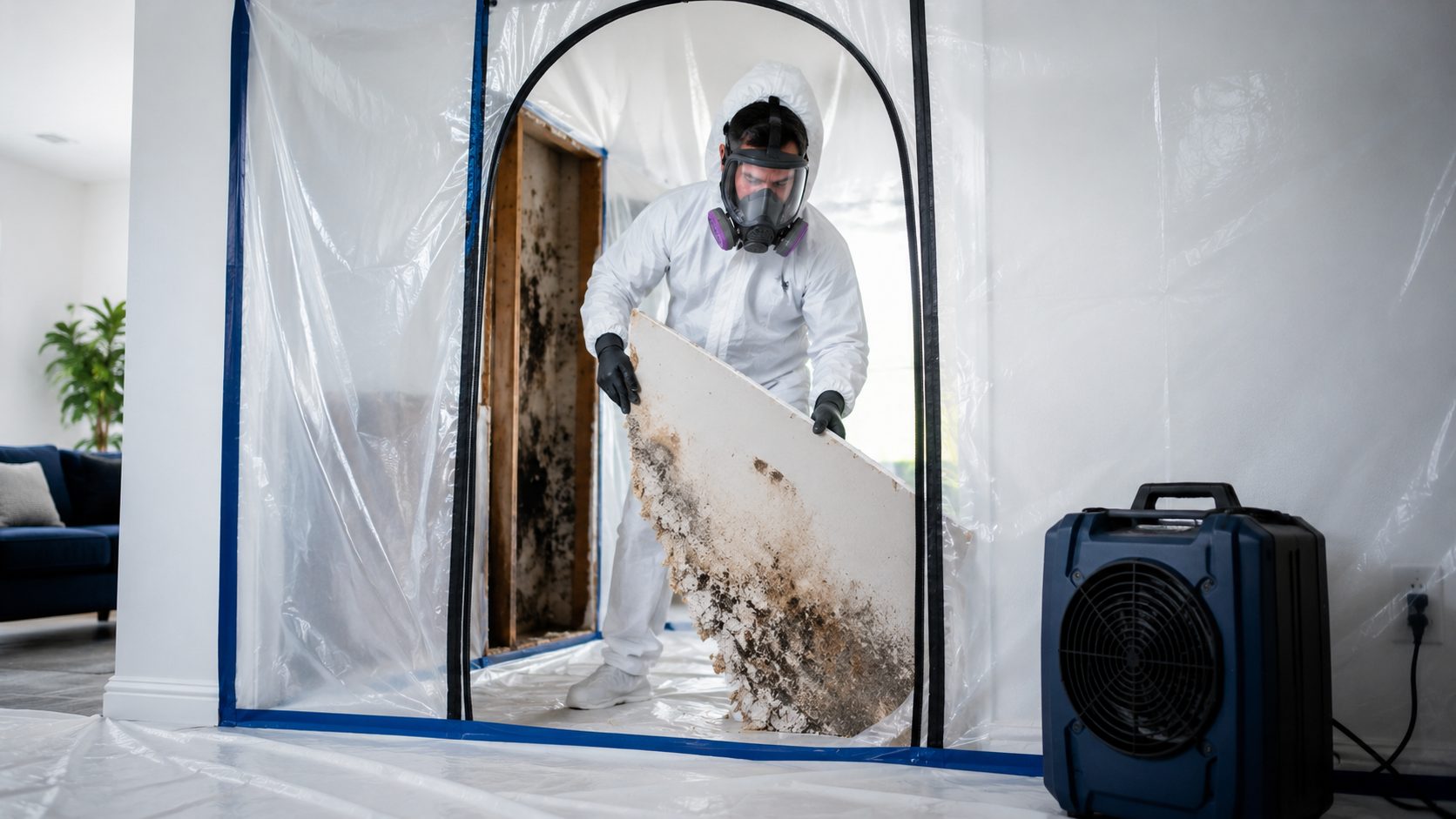
Commercial mold remediation isn't just residential work at a larger scale — it adds occupant safety obligations, business-continuity pressure, and documentation that can end up in a lease dispute or insurance claim. For a Los Angeles facility manager, the goal is to remove the mold at its source, keep employees and tenants safe, and get the space back in service with minimal downtime. Here's how professional commercial remediation achieves that.
Why commercial mold is different
- Occupants — employees, tenants, customers, or patients may need to keep using adjacent areas during the work.
- Liability — landlords and employers have duties around indoor air quality; how you respond can matter legally.
- Scale and systems — larger footprints, suspended ceilings, and shared HVAC can spread spores building-wide if not contained.
- Downtime cost — every day a space is offline has a dollar figure, so the plan must balance thoroughness with speed.
The compliance picture in California
California has no numerical "safe" limit for indoor mold, and the state doesn't license mold remediation as a standalone trade the way some states do. Instead, credible commercial work follows recognized standards and worker-safety rules:
- IICRC S520 — the industry standard for professional mold remediation (containment, removal, verification).
- Cal/OSHA — worker protection, respiratory protection, and hazard communication during remediation.
- ANSI/ACGIH guidance — assessment and control of bioaerosols.
For larger or disputed jobs, an independent industrial hygienist is often brought in to write the remediation protocol and to perform post-remediation verification — a separation of "who assesses" from "who remediates" that protects everyone.
How professional commercial remediation works
- Assessment & moisture source — find and fix the water source first; mold always follows moisture.
- Containment — seal the work area with negative air pressure and HEPA-filtered air scrubbers so spores don't spread through the building or HVAC.
- Removal — remove mold-damaged porous materials (drywall, ceiling tile, carpet) and HEPA-vacuum/clean non-porous surfaces.
- Drying & treatment — dry the structure and apply antimicrobial treatment where appropriate.
- Verification — visual clearance and, when required, third-party air/surface testing before rebuilding.
- Reconstruction — restore finishes to pre-loss condition.
Minimizing downtime
Downtime is usually the biggest hidden cost of commercial mold. Experienced crews reduce it by containing tightly so unaffected areas stay open, scheduling disruptive work for nights and weekends, isolating the affected HVAC zone, and sequencing remediation and reconstruction to overlap where safe. Clear communication with tenants and staff keeps the business running while the work proceeds. See our commercial restoration services.
Documentation you'll want on file
For commercial jobs, documentation isn't optional — it protects you in lease disputes, insurance claims, and employee-relations questions:
- The remediation protocol (scope, containment plan, methods).
- Moisture readings, photos, and daily logs.
- Waste-disposal records for removed materials.
- Post-remediation verification / clearance results.
Frequently asked questions
How much does commercial mold remediation cost in Los Angeles?
It varies widely with the size of the affected area, the building systems involved, and whether third-party testing and reconstruction are required. Commercial jobs are scoped after an on-site assessment rather than quoted by the square foot sight-unseen.
Do we have to close the whole building?
Usually not. Proper containment and negative air pressure let unaffected areas stay in use while the work area is isolated. The plan is built around keeping as much of your operation running as possible.
Who should test for mold — the remediation company?
For larger or disputed commercial jobs, best practice is to have an independent industrial hygienist assess and verify, separate from the company doing the removal. We work alongside third-party hygienists when a job calls for it.
Managing a mold problem in an LA commercial property? DKI Restotech handles commercial mold remediation across Los Angeles, Orange County, and Riverside. Call (949) 359-4090 for a facility assessment.
{# Google "Preferred Sources": readers add us as a preferred source so our articles surface more often in their Top Stories / news results. Official embed (button + deeplink fallback): https://developers.google.com/search/docs/appearance/preferred-sources #}Want more of our local restoration guides in your Google results?
Adds DKI Restotech to your preferred sources in Google Search. You can change it anytime.